• 1
  • 2
  • 3
  • 4

Activities

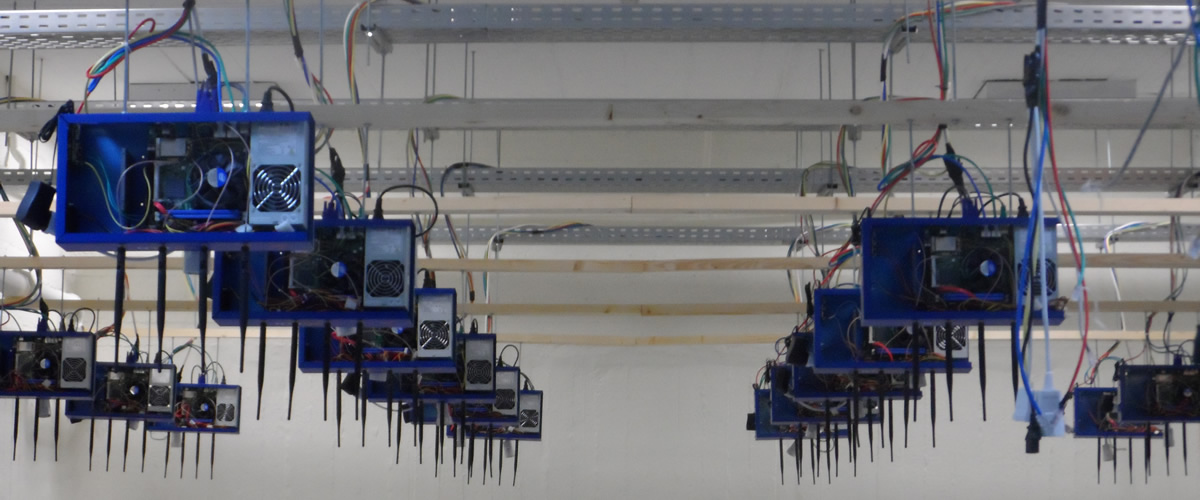
  • NITOS Outdoor deployment consists of powerful nodes that feature multiple wireless interfaces and allow for experimentation with heterogeneous (Wi-Fi, WiMAX,

    Read More
  • The setup NITOS testbed is currently using is a fixed setup (employing no mobility between BSs) that does not require

    Read More
  • Towards the development of a remote accessible LTE testbed, where experimenters from all the word will be able to run

    Read More
  • NITOS facility provides remote access to OpenFlow switches (2 x Pronto 3290 , 2 x HP 3800 ), enabling the user to create

    Read More
  • NITlab developed a software defined radio (SDR) testbed that consists of 18 Universal Software Radio Peripheral (USRP) devices attached to

    Read More
  • NITOS is an Intelligent Transport System (ITS) compatible facility thanks to the implementation of the key components of the ITS

    Read More
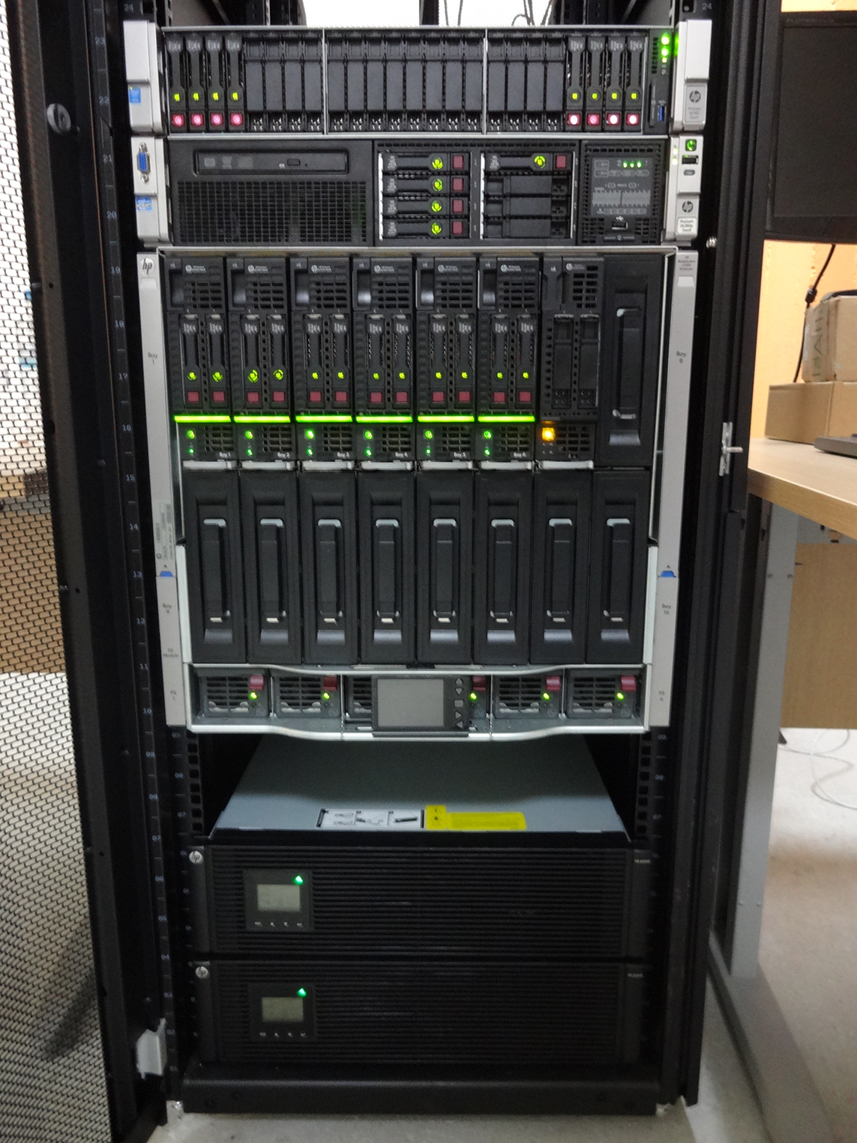
  • NITOS cloud infrastructure is based on HP GEN8 blade servers and one HP DL380p GEN8 server. Cloud Infrastructure UTH Each blade server has

    Read More

NITOS

The Future Internet Facility

  • Outdoor Testbed

    Experiments under real world environment Read More
  • Indoor Testbed

    Experiments in RF isolated environment Read More
  • Office testbed

    Experiments in an office environment Read More
  • 1
  • 2
  • 3

Dishonest Reporting in Queue-Based Cross-Layer Network Optimization

Authors: Dimitris Giatsios, Iordanis Koutsopoulos, Thanasis Korakis

Conference: International Workshop on Quality of Service (IWQoS) 2012, Coimbra, Portugal, June 2012

Abstract: Queue-based cross-layer optimization algorithms have recently been a subject of intensive research in wireless networks. Their purpose is to guarantee stable operation and to achieve some form of fairness among users, whenever the traffic demand exceeds network capacity. Despite the plethora of work in this field, the scenario where one or more nodes declare false queue backlog values in order to gain throughput advantage remains unexplored. In this paper we examine this type of selfish misbehavior, concentrating on a specific class of algorithms, the so-called quadratic Lyapunov-function-based algorithms (QLA). In particular, the effect of backlog misreporting on a single-hop access network with contending stations is evaluated through simulations. A simple framework for the detection of misbehaving nodes is proposed, under the assumption that the access-point is aware of the utility functions of the stations. The detection approach exploits the fact that under QLA the throughput of a node must be approximately equal to an “expected” value, derived from the reported queue backlogs.

Download paper here.

What Our Experimenters Say

  • NITOS is a very reliable and well managed platform. The offered infrastructure and features are great. The management team is very supportive.

    Mustafa Al-Bado
    Postdoctoral researcher
    Insight centre, University College Cork (UCC)
  • 1
  • 2
 
uth
image
image
image


Login Form